
The Ultimate Guide to Healthcare Public Relations
The healthcare sector is broad and brimming with innovation. Whether scaling a transformative health tech platform, launching a medical device, leading a payer organization, or expanding a clinical care network, modern healthcare brands are founded on expertise that must break through a crowded, complex, and highly regulated landscape to get noticed. And because healthcare decision-makers operate with deep skepticism, traditional consumer-style PR tactics often fail. Trust in healthcare is not a given. It is earned through narrative rigor, clinical evidence, and strategic market positioning.
This guide outlines how to build a high-impact healthcare public relations strategy that earns authority, gets visibility, and passes the credibility test with key audiences, turning health expertise into lasting market influence.
What Is Healthcare Public Relations?
Healthcare public relations is the practice of translating complex clinical, technological, and operational healthcare expertise into clear, compelling narratives that get seen, quoted, and repeated in the forums that matter most within the healthcare industry. It bridges the gap between what healthcare innovators build and how key decision-makers understand its value.
Effective healthcare PR aligns efforts across four critical stakeholder perspectives:
● Healthcare Providers (Clinicians and Health Systems): Seeking clinical efficacy, operational efficiency, and workflow integration.
● Payers and Employers: Focused on cost containment, risk mitigation, and demonstrable health outcomes.
● Patients and Consumers: Demanding accessibility, clear education, and human-centered care options.
● Regulators and Policymakers: Requiring compliance, transparency, and systemic value.
Why Generic PR Fails in Healthcare
Healthcare marketers often face a fundamental dilemma of balancing rigorous clinical accuracy with engaging human storytelling across effective marketing strategies. If messaging leans too far into heavy clinical jargon or regulatory compliance, it becomes dense, unreadable, and fails to key media outlets with the broadest readership. Conversely, oversimplified narratives risk diluting what differentiates the brand, alienating clinical experts, failing regulatory scrutiny, or losing credibility with B2B buyers.
Yet healthcare communication strategies require specialized technical fluency for more reasons than the subject matter alone. A successful approach also considers how the complex business of healthcare is conducted.
High-Stakes Scrutiny: Every claim requires proof. Unsubstantiated claims destroy credibility instantly among skeptical clinical committees.
Multi-Layered Decision-Making: B2B healthcare sales involve complex committees including Chief Medical Officers, CFOs, IT security leads, and procurement directors.
Regulatory Barriers: Navigating HIPAA guidelines, FDA clearance language, and compliance boundaries requires an agency partner with deep industry immersion.
The 5 Pillars of Strategic Healthcare Public Relations
A modern healthcare PR strategy must go beyond distributing press releases. Public relations is most effective as a multi-channel strategy that is tailored to specific organization-wide goals, combining multiple approaches like earned media, thought leadership, event activation, and digital authority. To shape market perception and drive commercial momentum
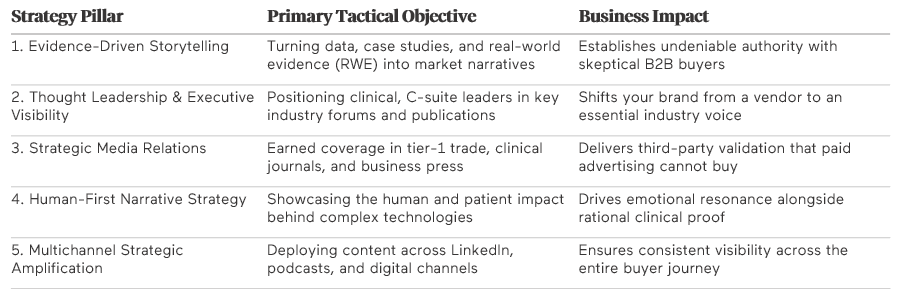
Pillar 1: Translating Data into Evidence-Driven Storytelling
Data alone rarely shifts mindsets with healthcare’s target audiences. Raw metrics must be woven into an authentic narrative. Whether showcasing reduced hospital readmissions, improved patient adherence, or lowered administrative overhead, present your data within a clear pattern with relevant context:
● The Problem: Define the systemic friction point or clinical gap in care.
● The Innovation: Explain how your approach uniquely addresses the challenge.
● The Proof: Validate your solution using peer-reviewed data, clinical trials, or real-world case studies that resonate with life sciences audiences.
Pillar 2: Positioning Executives as Key Industry Voices
Key opinion leaders (KOLs) and executive voices drive healthcare forward. Positioning your CEO, Chief Medical Officer, or product owners as trusted thought leaders builds long-term brand equity.
● Key Industry Forums: Secure speaking opportunities at influential events like HLTH, HIMSS, or specialized clinical symposia.
● Contributed Bylines: Publish expert opinion pieces in trusted trade publications (e.g., Fierce Healthcare, Healthcare IT News, Modern Healthcare).
● Trend-Jacking with Rigor: Jump on breaking news–such as regulatory shifts, AI policy updates, or public health announcements–by offering immediate executive commentary.
Pillar 3: Earning Media Placements That Drive Credibility
Earned media coverage remains the gold standard for third-party validation in healthcare. Specialized healthcare PR agencies are critical partners in extending brand awareness strategies beyond traditional media to the publications, podiums, and forums that healthcare decision-makers turn to for trusted insights.
To earn coverage in respected publications:
● Lead with Impact, Not Features: Journalists care about how an innovation changes care delivery or system economics, not product feature checklists.
● Leverage Independent Experts: Partner with uncompensated clinicians, academics, or patient advocates to serve as neutral, highly credible voices in your pitches.
● Respect Journalist Timelines: Supply complete press kits, high-res imagery, and pre-cleared executive availability.
Pillar 4: Balancing Human Impact with Clinical Precision
Behind every healthcare metric is a human story. Even in B2B healthcare marketing, where buyers are health system executives or insurance underwriters, decisions are still made by human beings.
● Humanize the Data: Frame operational improvements around how they give clinicians more time at the bedside or grant patients easier access to preventative care.
● Inclusive Language: Ensure brand messaging uses inclusive, accessible language that reflects diverse patient populations and modern care delivery models.
Pillar 5: Amplifying Your Voice via Targeted Digital Channels
Securing a major media placement or publishing a white paper is only the first step. To maximize return on investment, amplify your content across digital touchpoints, including social media, where decision-makers actively research and connect with peers.
● Targeted LinkedIn Campaigns: Target specific health system titles (e.g., CFOs, VPs of Clinical Transformation) with high-value thought leadership content.
● Podcast Guesting: Place executives on specialized B2B healthcare podcasts to dive deep into industry challenges and showcase their expertise.
Measuring Healthcare PR Impact
Measuring healthcare PR requires looking beyond vanity metrics to evaluate how messaging influences market positioning and business outcomes, including:
Share of Voice (SOV) in Target Outlets: Tracking your media presence against direct competitors across key healthcare trade press and industry topics.
Key Message Penetration: Ensuring published articles reflect your core value proposition and clinical differentiators.
Domain Authority & Inbound Search Equity: Measuring organic search growth and high-quality backlinks from authoritative health publications.
Pipeline Acceleration: Tracking how earned media placements, case studies, and executive visibility assist sales teams in closing high-value accounts.
Moving Healthcare Forward with Purpose
In an industry defined by rapid innovation and complex challenges, authority, expertise, and trust are your greatest competitive advantages. Winning market share requires a strategic communications partner who already understands the industry and has the proven ability to translate complex scientific expertise into influential narratives.