
Understanding Industrial Public Relations in Manufacturing
B2B manufacturing executives often experience public relations as an afterthought. Or if it is considered at all, it is conflated with marketing, lead generation, or brand awareness. And for good reason. When your everyday operations revolve around production throughput, supply chain logistics, equipment tolerances, and tight margins, promotional strategies can feel like a distraction from your most urgent business priorities. But that mindset costs many manufacturing and industrial leaders significant market share.
The reality is that B2B manufacturing deals run on high-dollar values, long sales cycles, complex engineering specifications, and multi-layered buying committees. Each of those factors demands trust between both parties. Manufacturing PR is how you build that trust.
This comprehensive guide breaks down what manufacturing PR actually does and why it is one of the highest-leverage growth drivers industrial brands aren’t using enough.
What Is Manufacturing PR?
Manufacturing public relations is the strategic management of trust and credibility with key business audiences and stakeholders. It is the deliberate practice of shaping how buyers, suppliers, investors, trade media, and future employees view your company’s technical expertise, reliability, and market value. It is the application of tailored communications strategies that makes your business’s expertise and its role in the larger industry visible to the right people.
As former Apple executive Jean-Louis Gassée put it, "Advertising is saying you're good. PR is getting someone else to say you're good."
PR in the industrial domain requires a specific approach because its primary goal is to translate complex technical capabilities into business narratives people actually care about. Good manufacturing PR answers three fundamental questions for your target market:
What you do: Clarifying your specific engineering, custom fabrication, or technological capabilities.
Why you do it: Demonstrating your core mission, standards, and commitment to quality.
Why it matters: Proving how your solutions solve real-world operational bottlenecks, reduce total cost of ownership, or advance industry standards.
The Business Case: Why PR Works for Industrial Brands
Manufacturing PR is a reliable solution to some of the most difficult-to-quantify challenges industrial businesses face. Proactive public relations can help modern manufacturers get ahead in more ways than just brand visibility. Here are some of the most common benefits of manufacturing PR:
1. Shortening the B2B Sales Cycle
Industrial buyers aren’t the type to be forthcoming with online form fills and requests for information. They rarely reach out to a sales representative until they have already done a foundational level of research on your brand, evaluated any trade publication coverage, and investigated your industry standing. Without an industry presence at this stage, many buyers may cut your business from the short list, if they knew about it at all. Strategic PR lays the groundwork at the top of the funnel, educating prospects and establishing credibility with buyers that otherwise may not have even knocked on the door.
2. Translating Technical Complexity into Business Value
Your engineers and plant managers are great at building superior products, but communicating why that engineering superiority should matter to executive decision-makers is not as easy as it sounds. PR bridges the gap between what your experts know and what your potential customers need.
3. Crisis Mitigation & Supply Chain Resilience
The connection between PR and material shortages, supply chain disruptions, and plant safety incidents may not be obvious. But those risks are inherent to the business of manufacturing, and it is inevitable that challenges will eventually arise from them. Proactive PR establishes trusted relationships with key stakeholders before a crisis hits, enabling transparent, controlled communication that protects your brand’s reputation.
4. Winning the War for Industrial Talent
Skilled labor shortages remain a persistent challenge across manufacturing. A strong industrial PR program enhances your profile with potential employees. Positioning your facility as an innovative, stable, and forward-thinking workplace helps attract top engineers, machinists, and operations leaders.
6 Pillars of an Effective Manufacturing PR Strategy
Public relations is most effective as a multi-channel strategy that is tailored to the specific goals of the organization. In that way, no two industry PR campaigns will look alike. But they should all blend some combination of earned media, thought leadership, event activation, and digital authority.
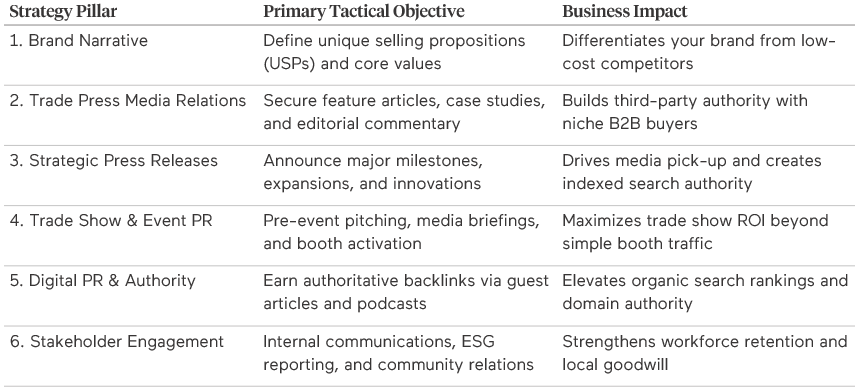
Pillar 1: Unearthing Your Core Brand Narrative
The best manufacturing PR strategy will fall flat if it isn’t true to your brand’s story. That’s why the first step is to define what sets your brand apart. A compelling industrial brand narrative goes beyond generic claims like "high quality" or "on-time delivery." It focuses on your distinct advantages:
Proprietary Process or Technology: What unique tooling, automation, or custom engineering methods do you leverage?
Problem-Solving Track Record: How has your team solved complex OEM challenges that others couldn't?
Value Alignment: How does your commitment to sustainability, local sourcing, or ISO certifications match the values of your key accounts?
Pillar 2: Visibility in Industry Trade Publications
Your ideal buyers, such as procurement managers, design engineers, plant directors, and executive leadership, read specialized trade media. Getting featured in respected publications (such as Manufacturing Today, IndustryWeek, Design News, or sector-specific vertical outlets) carries far more weight than paid advertisements. Here’s how to do it:
Contribute Technical Articles: Instead of pitching a promotional sales pitch, offer technical how-to articles, trend analysis, or case studies co-authored by your engineers that offer genuine value to readers.
Offer Expert Commentary: Position your executive team as reliable sources for journalists covering supply chain shifts, regulatory updates, or material innovations.
Lead with Data: Media outlets value proprietary data, benchmarking stats, and concrete case study metrics that only insiders like you have access to, over vague marketing claims.
Pillar 3: Leveraging Press Releases for Strategic Milestones
Press releases are far from outdated. Indeed, they remain a core element of B2B public relations when used intentionally. Avoid issuing releases for minor updates. Instead, save them for genuine, newsworthy milestones that will impact your local community or industry at large:
Facility expansions or new equipment investments
Major product line launches or technological breakthroughs
Key executive appointments or strategic acquisitions
Industry awards and safety achievements
Every release should include an attention-grabbing headline, concrete data points, direct quotes from leadership, and a clear call to action backed by a boilerplate linked to your website.
Pillar 4: Maximizing ROI at Industrial Trade Shows
Trade shows are a significant financial investment. Make sure they are worthwhile. To maximize your return, integrate PR into every stage of the event lifecycle:
Pre-Show (3-4 Weeks Out): Pitch trade journalists attending the event to schedule 1-on-1 booth briefings.
At-Show: Host live product demonstrations, present on speaker panels, and share real-time updates on LinkedIn.
Post-Show: Package event insights into a post-show blog series, media recap, and targeted email campaign.
Pillar 5: Digital PR, Search Engine Authority, and Link Equity
Modern public relations, digital marketing, and Search Engine Optimization (SEO) strategies all support each other directly, compounding performance and return on investment. When respected trade publications feature your company online and link back to your website, search engines view your domain as a trusted industry authority, serving it to more potential customers.
Pillar 6: Activating Employees and Local Community Relations
No one knows your business better than your frontline workforce and community partners. They are powerful brand advocates, and critical players in reinforcing your credibility right at the source. No PR strategy would be complete without telling their story.
Employee Advocacy: Sharing employee spotlights, apprenticeship successes, and safety milestones fosters internal pride and demonstrates workplace culture to prospective hires.
Community & Corporate Social Responsibility (CSR): Highlighting sustainable manufacturing practices, local STEM partnerships, or environmental stewardship builds community goodwill and supplies local media with positive human-interest stories.
Measuring Manufacturing PR Success
Public relations is one of the best ways to build long-term brand equity. Yet its impact can be difficult to quantify. Here are some of the most powerful ways to demonstrate the value of an industrial PR program:
Share of Voice (SOV): How frequently your brand is mentioned in target trade media compared to direct competitors.
Quality of Media Placement: Tier-1 trade features vs. passive directory listings.
Organic Search Traffic & Referral Traffic: Increased website visits driven by backlinks embedded in editorial coverage.
Domain Authority Growth: Measurable improvement in your website's search engine authority metrics via earned links.
Inbound Lead Quality: An increase in inbound inquiries referencing trade articles, industry speaking engagements, or media coverage.
Making the Transition from Factory Floor to Market Leader
The global market is only getting more competitive. Superior manufacturing capabilities alone are no longer enough to guarantee growth. To win high-value accounts, attract skilled talent, and maintain market leadership, your brand narrative must be as precise and high-performing as the products you build.
Unfortunately, many manufacturing organizations lack the resources, media connections, or workforce bandwidth to build and execute a consistent PR program. That’s where an experienced PR partner, immersed in the manufacturing industry help you build the credibility needed to dominate your sector.